A New Education Year: Starting Small After September 1
September is easier for children when routines and learning skills are practised in small, clear steps.
September 1 has a special sound in many homes: new shoes near the door, sharpened pencils, a lunchbox being tested, and a child asking one more question before the morning begins. In Lithuania, the general education school year traditionally begins on September 1, while in other countries and even regions the date can be different. Some families return to school in August, some in early September, and some follow a local calendar shaped by climate, holidays or national rules. For children, the exact date is less important than the feeling of transition. A new education year asks them to remember routines, listen to adults, manage emotions, sit for longer, try again after mistakes, and meet many little expectations in one day.
For parents, teachers and support specialists, September is not only about buying supplies. It is the month when children show us what they can do confidently and what still needs gentle practice. Some children arrive ready to count, write, cut, colour and follow instructions. Others need a slower bridge between holiday rhythm and classroom rhythm. Printable activities can help because they turn big school-readiness skills into small, visible steps. A page can ask for one action at a time: find, count, trace, match, colour, circle, compare, or complete. That kind of clarity matters when a child feels overwhelmed by a new group or a new timetable.
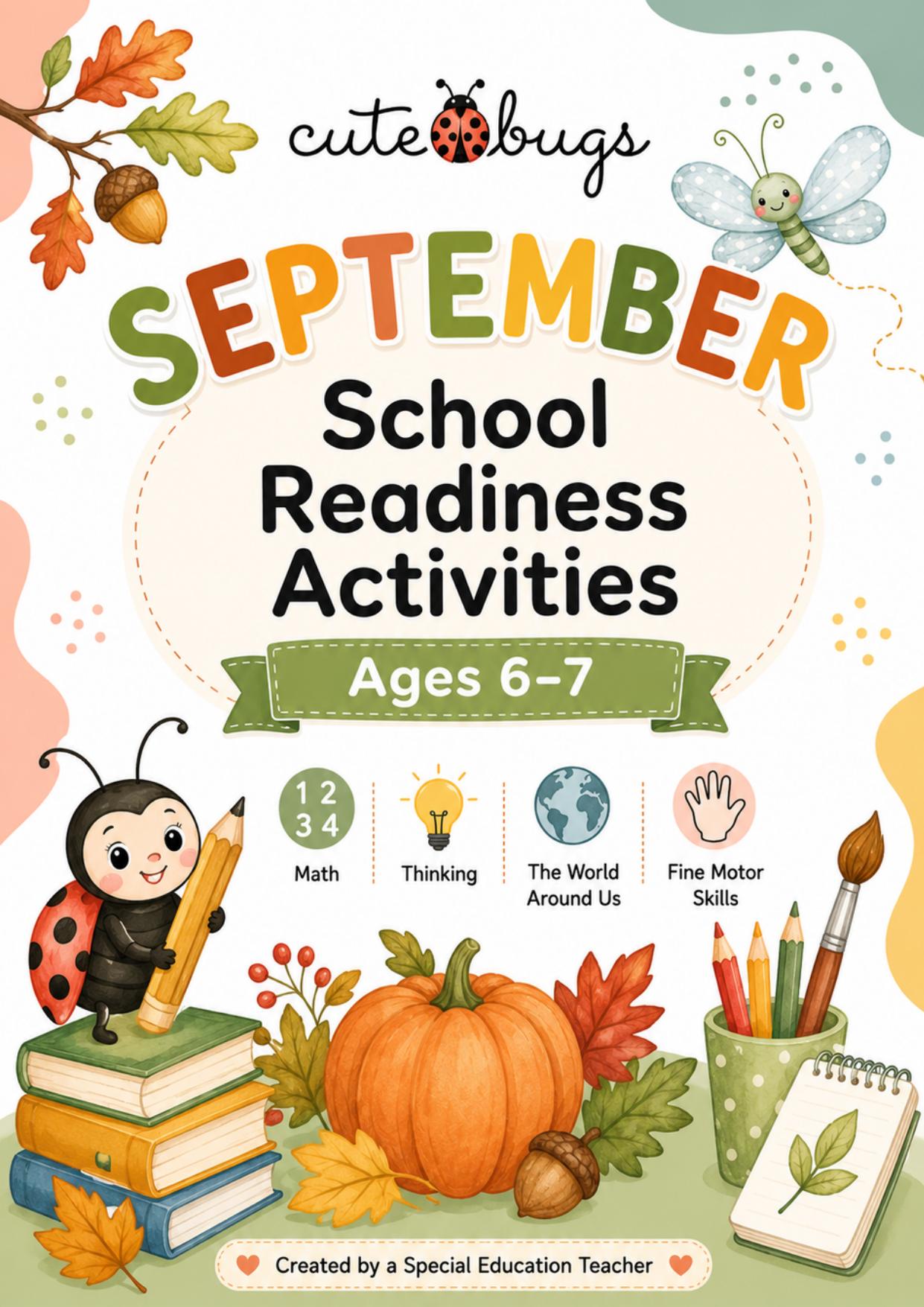
Cutebugs materials are designed for this bridge. The September School Readiness Activities - Ages 6-7 pack gives children autumn-themed practice across early math, thinking skills, fine motor work and world-around-us tasks. It is useful at the beginning of the school year because it does not treat readiness as one skill. A child may count well but struggle to hold a pencil comfortably. Another child may know many facts but rush through visual details. A balanced pack helps adults notice these differences without turning learning into a test.
Younger children also benefit from a calm start. The Early Counting Activities - Numbers 1-3 pack focuses on small numbers, matching, tracing and colouring. This is not too simple when the goal is confidence. Numbers 1 to 3 can be practised through quantity, movement, observation and hand control. When a child repeats the idea in several formats, they begin to understand that numbers are not only symbols on a page. They are groups, actions and choices.
Teachers can use September printables for morning work, small-group support, early finishers or observation. Parents can use them after school in short sessions: one page, one pencil, one calm adult nearby. The aim is not to fill every evening with worksheets. The aim is to create predictable, low-pressure moments where a child can succeed. Five focused minutes can be more useful than thirty tired minutes.
A good start to the education year is not perfect behaviour and perfect pages. It is rhythm. It is knowing where the backpack goes, how to ask for help, how to try a new task, and how to finish something small. When printable activities are clear, warm and purposeful, they become part of that rhythm. September can feel big, but learning can begin small. A practical plan for the first two weeks is to choose one focus at a time. On Monday, print one counting page. On Tuesday, choose one fine motor page. On Wednesday, repeat a familiar task so the child can feel faster and more independent. On Thursday, invite the child to explain the page to you. On Friday, keep the best page and celebrate the progress. This simple rhythm helps adults see what is improving and helps children feel that school practice belongs to everyday life, not only to formal lessons.